

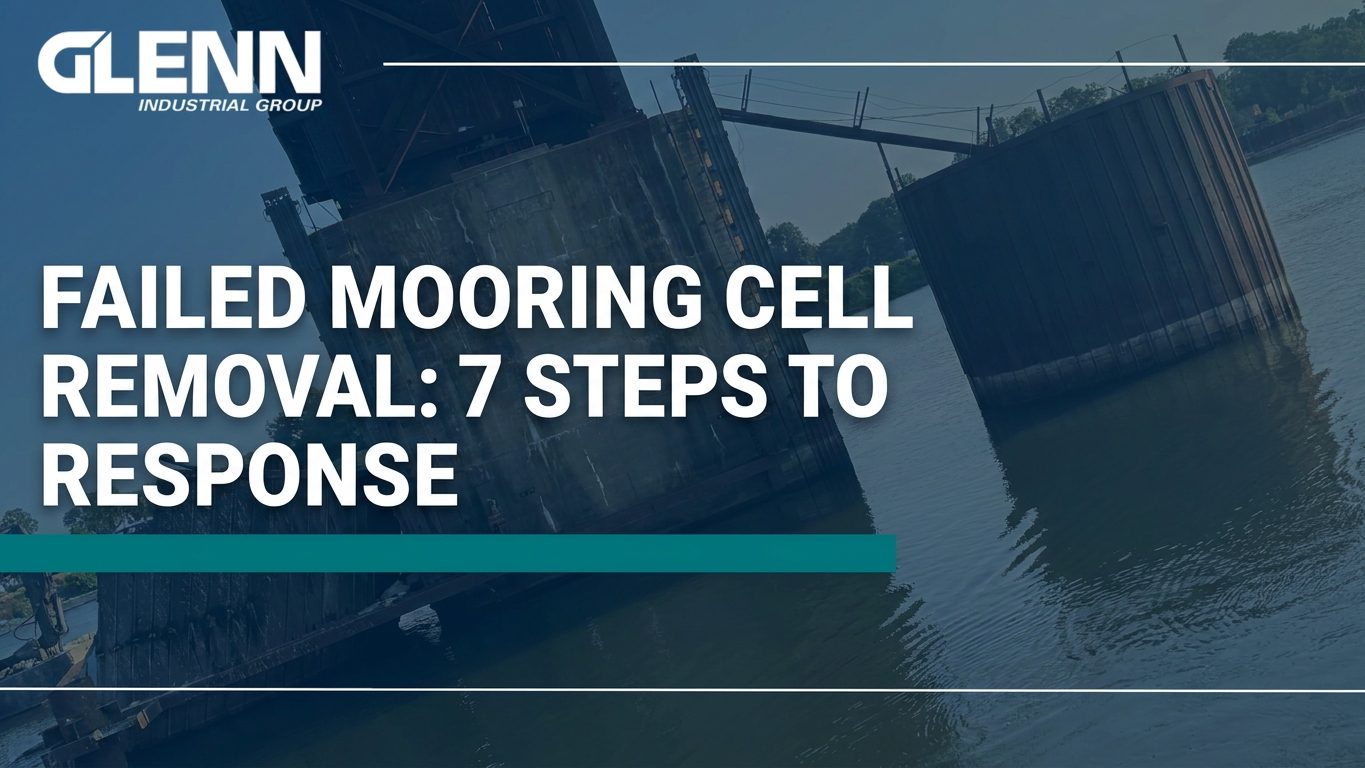
Failed Mooring Cell? A Rapid-Response Playbook to Protect Your Schedule and Budget
7-minute read
In the high-stakes field of marine infrastructure, an unforeseen failure in a mooring cell can derail entire projects, leading to spiraling costs and intense pressure on project managers. This type of disruption jeopardizes timetables and imposes unwelcome stress on contractors, who face the prospects of costly delays and reputational damage. The anxiety of seeing project timelines disintegrate due to factors outside of your immediate control is a pressing concern. This is where Glenn Industrial Group excels, restoring order amidst chaos and keeping project timelines intact despite initial disruptions.
Imagine having the precise strategies at your fingertips to rapidly resolve failed mooring cell situations as they arise. Count on this article to arm you with essential techniques to efficiently manage these high-tension crises. We’ll uncover the crucial steps for addressing failed mooring cells, focusing on rapid response and the proven, technical prowess necessary to maintain project schedules and ensure resilience in your infrastructure. With increased global maritime traffic in 2026, mastering these techniques is invaluable for avoiding costly disruptions and maintaining competitive edge.
In the high-stakes field of marine infrastructure solutions, an unforeseen failure in a mooring cell can derail entire projects, leading to spiraling costs and intense pressure on project managers. This type of disruption jeopardizes timetables and imposes unwelcome stress on contractors, who face the prospects of costly delays and reputational damage. The anxiety of seeing project timelines disintegrate due to factors outside of your immediate control is a pressing concern. This is where Glenn Industrial Group excels, restoring order amidst chaos and keeping project timelines intact despite initial disruptions.
Imagine having the precise strategies at your fingertips to rapidly resolve failed mooring cell situations as they arise. Count on this article to arm you with essential techniques to efficiently manage these high-tension crises. We’ll uncover the crucial steps for addressing failed mooring cells, focusing on rapid response services and the proven, technical marine expertise necessary to maintain project schedules and ensure infrastructure resilience strategies in your infrastructure. With increased global maritime traffic trends in 2026, mastering these techniques is invaluable for avoiding costly disruptions and maintaining competitive edge.
Key Takeaways
- ✓ Triage quickly: secure the site, halt escalation, and capture data within the first hour to protect schedule and budget.
- ✓ Diagnose the failure mode (corrosion, scour, fill loss, impact, structural distress) using divers, ROVs, and NDT for a right-first-time repair plan.
- ✓ Stabilize and contain: temporary shoring, grout, tremie plugs, and silt control prevent further damage while engineering the fix.
- ✓ Execute permanent repairs with integrated Commercial Diving, Dredging, Industrial Salvage & Recovery, ROV Services, and Marine Construction capabilities.
- ✓ Verify, document, and harden for the future with QA, as-builts, and a preventive resilience program.
Need Expert Underwater or Heavy Civil Solutions?
From commercial diving and dredging to ROV inspections and marine construction — Glenn Industrial Group delivers safe, compliant, cost-effective results.
Table of Contents
Assess Immediate Risks and Secure the Site
When a mooring cell shows distress (settlement, cracking, lean, or loss of backfill), minutes matter. Start with life-safety and asset protection, then move to rapid diagnostics.
- Create an exclusion zone; control vessel movements and isolate utilities and electrical hazards.
- Deploy spill kits and containment boom to protect water quality while you assess the damage.
- Capture baseline data: photos, video, deformation markers, water levels, and incident timeline.
- Initiate a rapid condition survey: topside visual, bathymetry, side-scan/3D, and diver or ROV reconnaissance.
 Quick Tip: Pre-stage an emergency kit with silt curtains, sandbags, grout packs, spill response gear, and survey targets. Those first 60 minutes define the rest of the project.
“In a mooring cell emergency, slow is smooth and smooth is fast. Lock down safety, gather crisp data, and then act decisively.”
Diagnose the Failure Mechanism
Right-first-time repairs hinge on understanding what failed and why. Typical modes include:
- Corrosion and section loss in sheet piles or tie-rods; failed interlocks or welds.
- Scour at the toe causing loss of confinement and differential settlement.
- Internal fill loss from piping or void migration; compromised core material.
- Impact damage from berthing or mooring loads exceeding design assumptions.
- Overstressed diaphragms, rings, or walers from cyclic loading and fatigue.
Collect quantitative evidence: underwater video, UT thickness readings, cathodic protection potentials, sub-bottom data, CPT/borings (where feasible), current profiles, and crack/tilt mapping. Use a root-cause matrix to align symptoms with mechanisms and prioritize stabilization steps.
Quick Tip: Pair rapid response services with ROV reconnaissance first, then send commercial divers to verify high-value targets. It speeds decisions and reduces exposure.
Stabilize, Contain, and Control Environmentals
Temporary measures buy time, reduce risk, and create safe conditions for permanent work:
- Temporary bracing/walers, clamp-on collars, or struts to reduce movement.
- Sandbag rings, tremie plugs, or low-mobility grout to seal voids and arrest piping.
- Silt curtains, turbidity monitoring, and controlled dredging to manage water quality.
- Tie-rod inspection and controlled preloading; install temporary anchors if required.
- Survey prisms/targets and automated alerts to track deflection and settlement.
 Case Study
 Case Study
A Gulf Coast terminal reported rapid settlement at a sheet-pile mooring cell. Within hours, ROV mapping identified a scour hole and interlock separation. A tremie sand-cement plug and external clamp collars stabilized the structure, allowing controlled berthing on adjacent cells and preventing a full facility shutdown. Permanent repairs followed under normal operations.
Engineer and Execute Permanent Repairs
Design solutions should match the diagnosed mechanism and site constraints. Common packages include:
- Sheet pile replacement or encasement; interlock repairs and sealants; diaphragm/ring beam reinforcement.
- Grout injection to fill voids and re-establish confinement; low-permeability cutoff walls.
- Tremie concrete caps and toe keys; armor stone or articulated mats for scour control.
- Tie-rod replacement/upgrades and anchorage rehab; fatigue mitigation details.
- Corrosion mitigation: coatings, cathodic protection, and anode retrofits.
An integrated field team across Commercial Diving, Dredging, Industrial Salvage & Recovery, ROV Services, and Marine Construction compresses schedules, reduces interfaces, and keeps risk low while meeting engineering criteria and compliance requirements.
Schedule a Free Project Consultation
Tell us about your project. Our team will assess your needs and provide a tailored solution — no obligation.
QA, Verification, and Schedule Recovery
- Verification: diver/ROV video, UT/PMI/NDT as applicable, load checks on bollards, and surveyed as-builts.
- Compliance: environmental logs, turbidity records, and materials traceability.
- Schedule recovery: phased access to adjacent cells, temporary fendering, and optimized berthing windows to reclaim lost time.
- Handover package: O&M guidance, inspection intervals, and spares list for critical components.
Quick Tip: Align QA checkpoints with your project schedule management milestones so inspections never become the critical path.
Build Long-Term Resilience
- Condition monitoring: corrosion potentials, tilt sensors, and periodic bathymetry to track scour.
- Programmed inspections via commercial divers and ROVs tied to traffic intensity and seasonal currents.
- Risk registers with trigger points and a pre-approved rapid response playbook.
- Design upgrades that reflect rising maritime traffic trends and load profiles.
- Standardized details for scour armor, interlocks, and anode retrofits across facilities.
These infrastructure resilience strategies drive down lifecycle risk, stabilize budgets, and maintain competitiveness amid growing global demand.
Conclusion
A failed mooring cell is a high-stress event, but it doesn’t have to be a schedule killer. Secure the scene, diagnose precisely, stabilize smartly, and execute a targeted repair with integrated Commercial Diving, Dredging, Industrial Salvage & Recovery, ROV Services, and Marine Construction. Back it all with rigorous QA and a forward-looking resilience plan, and you’ll protect your timeline, budget, and reputation—project after project.
Ready to Start Your Project?
Call our 24-hour hotline at 704-540-9777 or schedule a free consultation with Glenn Industrial Group today.
FAQs
What are the most common causes of mooring cell failure?
Corrosion/section loss, scour at the pile toe, interlock separation, internal fill loss, impact damage, and overstressed tie-rods/diaphragms are frequent culprits. A structured root-cause review prevents repeat failures.
How quickly can an assessment team mobilize?
Rapid mobilization is essential. Initial remote triage can begin immediately, followed by on-site reconnaissance using ROVs and commercial divers as conditions allow.
Do permanent repairs require shutting down the entire facility?
Not always. With proper stabilization, phasing, and temporary fendering, many facilities maintain partial operations while repairs proceed on the affected cell.
How do you inspect underwater conditions safely and efficiently?
Start with ROV mapping for rapid situational awareness, then deploy commercial divers for targeted verification, measurements, and repairs. This sequence minimizes risk and accelerates decisions.
What documentation should I expect at closeout?
As-builts, inspection videos/photos, NDT results, environmental compliance logs, materials traceability, and O&M guidance with recommended inspection intervals.