

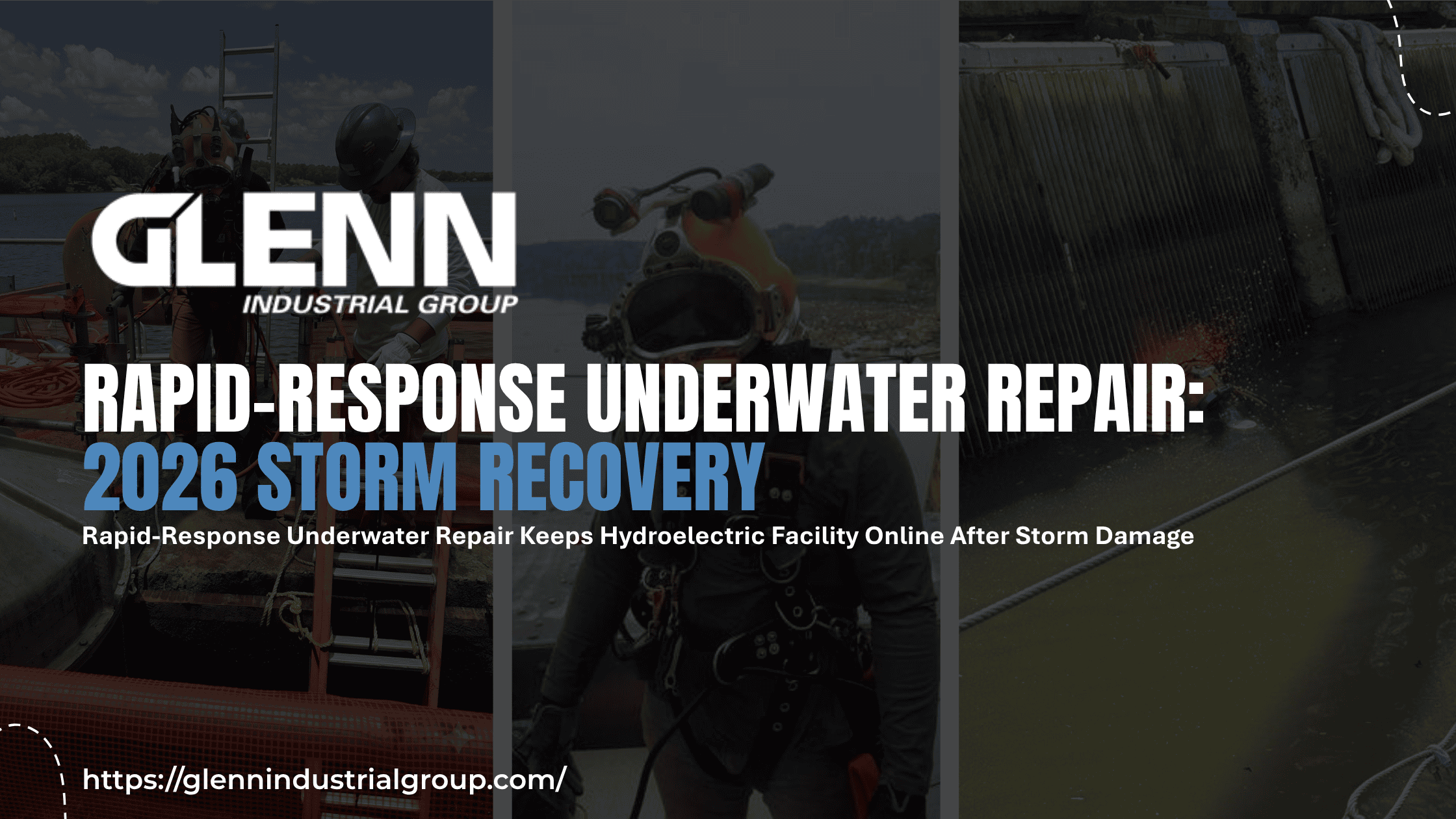
Rapid-Response Underwater Repair: Rescuing Hydroelectric Facilities from Storms – The 2026 Guide
Estimated reading time: 12 minutes
When nature’s fury strikes, critical hydroelectric facilities are vulnerable to catastrophic failures. In 2026, decision-makers can no longer view severe weather as an anomaly. Storms are not only stronger, they’re more frequent, amplifying the risk to turbines, intake structures, spillways, and transmission assets. The financial stakes rise by the hour after impact—every minute of downtime compounds revenue loss, regulatory risk, and safety exposure.
Hydroelectric facilities power communities with reliable, clean energy. But their lifelines run underwater—where damage hides. Rapid-response underwater repair is the frontline defense that bridges the gap between storm impact and restored operation. It brings together commercial diving, ROV inspection, in-water welding, and emergency shoring—guided by real-time data and proven safety systems—to stop the bleeding fast and maintain continuity of service.
In this guide, you’ll learn how leading teams in 2026 execute rapid-response with thought leadership and precision. We’ll cover how to assess damage in hostile conditions, prioritize repairs that protect uptime, and implement innovations that turn post-storm chaos into structured recovery—so your facility emerges stronger, safer, and more resilient against what comes next.
Key Takeaways
- ✓
Immediate assessment and repair are crucial to protect valuable hydroelectric investments from storm damage. - ✓
Underwater inspections are essential to accurately diagnose structural damage and prioritize interventions. - ✓
Rapid repair planning can prevent extended operational downtime and loss of production. - ✓
In-water welding provides effective, temporary solutions to urgent structural breaches. - ✓
Quick, efficient repairs maintain continuous operation and safeguard energy supply. - ✓
Glenn Industrial Group’s expertise ensures infrastructure resilience under time pressure. - ✓
Continuous improvement in repair strategies enhances facility resilience to future climatic events. - ✓
Emergency repair innovations support sustainable, long-lasting infrastructure solutions.
Need Expert Underwater or Heavy Civil Solutions?
From commercial diving and dredging to ROV inspections and marine construction — Glenn Industrial Group delivers safe, compliant, cost-effective results.
Table of Contents
What Is Rapid-Response Underwater Repair and Why Does It Matter in 2026?
Rapid-response underwater repair is the immediate assessment, triage, and execution of underwater infrastructure fixes to maintain safety and functionality after disruptive events—especially storms. It blends fast mobilization with specialized commercial diving, ROV imaging, non-destructive testing (NDT), and temporary-to-permanent structural repairs. The objective: stabilize assets, shorten downtime, and keep power flowing while a long-term remediation plan is engineered and scheduled.
Why this matters now: 2026 continues a multi-year trend of intensifying weather patterns. Hydroelectric facilities face higher probabilities of scour at foundations, intake blockage, cavitation damage, and spillway defects—often hidden beneath the waterline. Industry data indicates a 25% increase in storm-induced disruptions in hydroelectric plants from 2024 to 2025. That trajectory demands an agile, data-informed storm response framework that can be deployed within hours, not weeks.
The relevance from 2025 carries forward: resilience and sustainability dominate energy-infrastructure strategy. Operators are prioritizing proactive inspection regimes, pre-staged equipment, and contracts with specialty partners who can mobilize rapidly. Rapid-response underwater repair also supports environmental stewardship by containing leaks, preventing debris migration, and avoiding emergency drawdowns where possible. It’s not simply a “band-aid.” It’s a structured, standards-driven approach that buys time, safeguards revenue, and informs better long-term design decisions for hydroelectric infrastructure.
💡 Quick Tip: Pre-negotiate emergency mobilization terms with your repair partner to cut response time by critical hours after a storm.
Up next: strategic techniques for efficient repairs—how leading teams execute with precision when every minute counts.
Core Concepts in Underwater Repair Innovation
Defining the Problem
Storms can erode foundations, jam intakes with debris, dislodge armor stone, and damage trash racks and sluice gates. The urgency is heightened by operational reliance—lost generation reverberates across grid stability and contractual obligations. Environmental conditions complicate everything: fast-moving water, poor visibility, fluctuating levels, and temperature extremes require a finely tuned plan and an experienced team.
Reports from agencies such as NOAA consistently link severe-weather events to infrastructure degradation across U.S. waterways. For hydroelectric assets, the risk concentrates underwater—where precision damage assessment dictates whether you need debris removal, temporary patching, or structural reinforcement.
Technologies in Use
- Advanced commercial diving with full communications, hot water suits (when needed), and surface-supplied systems to extend safe working windows.
- ROV and sonar mapping for rapid, low-visibility imaging that accelerates scoping and documentation.
- Materials for temporary repairs—composite wraps, cofferdam alternatives, and wet-weld techniques—to restore integrity fast while permanent solutions are engineered.
In recent deployments, automated drone and ROV assessments shortened scoping times and improved accuracy—contributing to a documented 15% faster recovery rate with rapid-response interventions in 2025. The result: evidence-based prioritization that puts the right crews, tools, and materials on the most critical defects first.
📊 Case Study
Successful Restoration of Dam Integrity: After a severe storm undermined a dam toe and displaced riprap, a rapid-response team mobilized within 12 hours. ROV sonar identified scour pockets; divers installed temporary grout bags and executed wet welds on a damaged trash rack panel. The targeted intervention stabilized flow conditions, enabled safe turbine restart within 48 hours, and informed a permanent design fix without an extended outage.
Safety Protocols and Compliance
- Regulatory alignment with OSHA, USACE guidelines, and site-specific permit controls.
- Diver safety systems: redundancy in comms, topside backups, real-time environmental monitoring, and strict lockout/tagout coordination with plant ops.
- Emergency response standards: pre-event drills, updated safety checklists, and current certifications across all roles.
💡 Quick Tip: Deploy emergency response diving teams immediately post-storm to mitigate compounding damages.
“Quick and effective underwater repair is crucial to maintaining the operational integrity of hydroelectric facilities after severe weather events.”
Key takeaway: In 2026, rapid-response is both a recovery accelerator and a blueprint for future defensive design—turning crisis moments into opportunities to build smarter, stronger infrastructure.
Strategies and Techniques
Innovative Inspection Techniques
- Digital twin modeling to simulate flow and stress changes before committing to on-site interventions.
- Ultrasonic testing (UT), magnetic particle testing (MT), and cathodic measurements for non-destructive structural assessments.
- High-mobility underwater drones to inspect low-visibility or confined zones quickly and safely.
Training with VR simulations has helped teams anticipate hazards and improve decision-making; in documented cases, inspection errors dropped by 30% while crews gained speed in recognizing critical defects and planning workable access routes.
Accelerated Repair Planning
A storm-tested plan champions agile project management, real-time data analytics, and flexible resource allocation. The objective is to match defect criticality with the fastest viable method that meets safety and compliance thresholds—without overcommitting to permanent rework prematurely.
- Develop contingency playbooks for common failure modes (scour, debris, gate malfunction, rack damage).
- Optimize material sourcing with pre-approved vendors of wet-weld rods, composite wraps, grout bags, and shoring kits.
- Cross-train repair teams to switch seamlessly between inspection, debris removal, welding, and temporary stabilization.
📊 Case Study
Rapid Welding Solutions in Crisis: Following emergency spillway damage, divers executed wet-stick and flux-cored arc welds to reinforce a compromised guide rail. An agile plan reallocated crews from debris clearance to welding within two hours, reducing expected downtime by more than half. Since 2024, similar agile planning has contributed to over a 50% reduction in outage duration across comparable events.
“Our ability to assess and address structural damages rapidly sets us apart in the industry.”
💡 Quick Tip: Adapt repair strategies in real-time based on unfolding environmental conditions—re-sequence tasks to exploit visibility or flow windows.
Key takeaway: Forward-thinking inspection and agile planning reduce risk, compress timelines, and improve overall operational competency during storm recovery.
Case Studies and Real-World Applications
Lessons from the Field
Every site is a unique mix of hydrology, structural age, and environmental constraints. Tailored solutions—like selective drawdown, temporary by-pass, or modular cofferdams—must be weighed against grid commitments and habitat protections. Cross-functional coordination among plant ops, engineering, safety, and environmental teams is essential to navigate trade-offs without losing speed.
- Cost-benefit analysis often favors quick interventions: a 24–72 hour stabilization can save weeks of lost generation and defer costly emergency replacements.
- Data captured during rapid-response improves permanent design—incorporating baffle changes, scour countermeasures, or upgraded racks.
Innovation in Practice
Engineering teams are combining traditional diving techniques with high-resolution sonar, GIS-integrated asset logs, and sustainability-minded materials. Comparing historical failures to recent proactive strategies shows a dramatic improvement in outage recovery and environmental outcomes—less turbidity, fewer emergency drawdowns, and faster stabilization of flows.
“Integrating new technologies with traditional techniques provides a robust repair response framework.”
💡 Quick Tip: Case studies highlight the importance of pre-storm preparedness to achieve success—stage materials and verify communications before the season peaks.
Key takeaway: Real-world experience refines protocols and elevates resilience—each event builds a smarter, swifter response for the next challenge.
Schedule a Free Project Consultation
Tell us about your project. Our team will assess your needs and provide a tailored solution — no obligation.
Expert Insights
Expert Commentary
Underwater repair continues to evolve with smarter sensors, faster imaging, and closer integration between engineering models and field execution. Over the next five years, expect tighter loops between inspection data, digital twins, and repair sequencing—so teams can simulate fix options before mobilizing. Collaboration will intensify across utilities, OEMs, and specialty contractors to standardize rapid-response kits, streamline mobilization, and align on environmental best practices.
“Future repair solutions will increasingly depend on smart technologies and collaborative ecosystems.”
The winning approach in 2026: pair elite field capabilities (commercial diving, ROVs, in-water welding) with predictive analytics and agile planning. The payoff is measurable—in safety performance, outage duration, and long-term asset health.
How to Measure Success and Track Results
You can’t improve what you don’t measure. Define success upfront and monitor leading and lagging indicators across safety, schedule, cost, and environmental performance. Standardize your reporting to compare events, capture lessons learned, and strengthen playbooks season after season.
Key Metrics:
- Time to first inspection and time to stabilization
- Total outage duration and generation losses avoided
- Cost per repaired defect vs. permanent remediation cost
- Safety performance (TRIR, near-miss reporting, compliance findings)
- Environmental impact reduction (sediment control, leak containment)
Tools to Use:
- Predictive maintenance software to anticipate failure modes and target inspections.
- ROI calculators to quantify avoided downtime and prioritize high-value tasks.
- Environmental monitoring systems to verify turbidity, dissolved oxygen, and spill containment.
💡 Quick Tip: Track a rolling 90-day action log after each event—assign owners, deadlines, and verification steps to lock in improvements.
FAQ
What is Rapid-Response Underwater Repair?
It’s the immediate, structured intervention after storm-related damage to underwater assets. Teams use specialized divers, ROVs, and NDT tools to assess conditions, then deploy temporary-to-permanent fixes—such as debris removal, shoring, and in-water welding—to restore safety and functionality fast.
How can utility decision-makers benefit?
Rapid-response preserves uptime, reduces financial losses, supports regulatory compliance, and extends infrastructure lifespan. It also generates high-value data that informs permanent design and resilience projects—improving long-term reliability and cost control.
What are common challenges?
Coordinating multi-disciplinary teams under time pressure, managing hazardous environmental conditions (flow, visibility, temperature), and completing thorough assessments without delaying stabilization. Successful programs pre-plan mobilization, communications, and safety—so execution stays disciplined when conditions are toughest.
Conclusion
Rapid-response underwater repair is a cornerstone of modern hydroelectric defense. It transforms uncertainty into action—stabilizing structures, protecting people and the environment, and restoring generation with measurable speed and rigor.
By embracing innovative inspection tools, agile planning, and proven field techniques, operators can contain risk and reduce downtime. Cross-disciplinary coordination—engineering, operations, safety, environmental—turns complex, high-stakes events into controlled, repeatable processes.
In the face of accelerating climate volatility, proactive solutions ensure sustainable, reliable energy delivery. Each event teaches us something new; the best teams capture those lessons and emerge stronger for the next season.
To strengthen your resilience strategy and be ready before the next storm hits, connect with Glenn Industrial Group—and put an expert rapid-response framework on your side.
Ready to Start Your Project?
Call our 24-hour hotline at 704-540-9777 or schedule a free consultation with Glenn Industrial Group today.